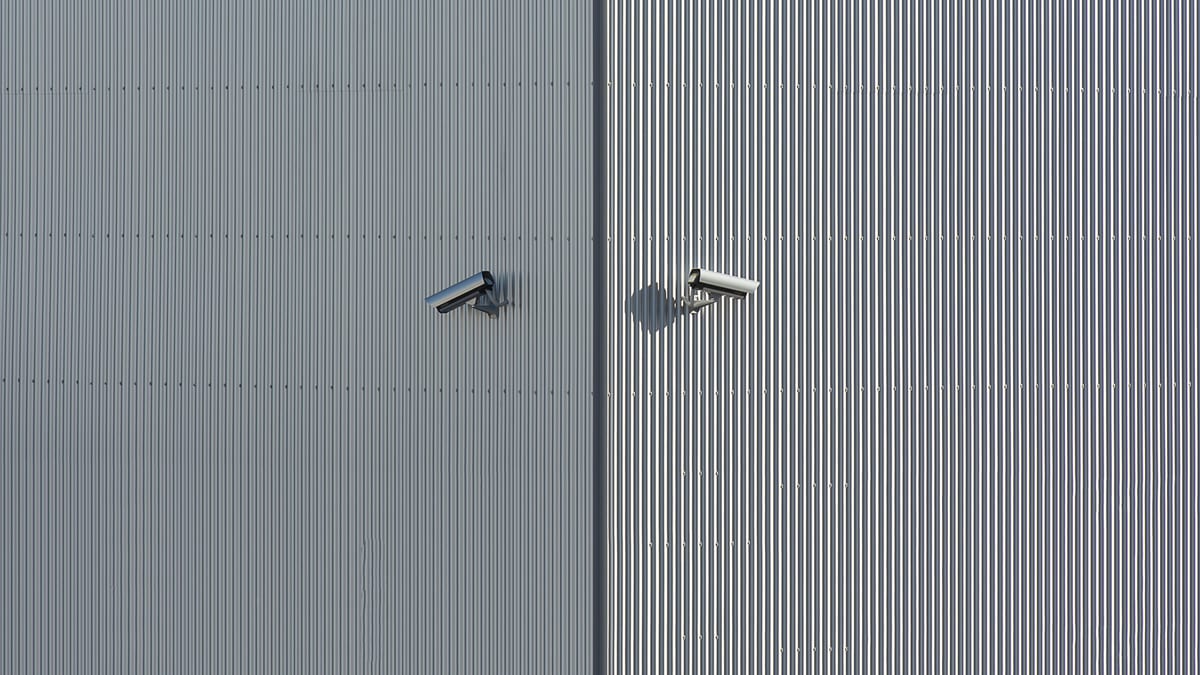
An electrical installation firm that adds alarm and camera fitting to its ordinary work soon reaches the question whether it needs a licence for that. And when customers start wanting someone to monitor alarms around the clock and attend on intrusion, another question arises. Act No. 473/2005 Coll. on Private Security distinguishes between a technical service and a security service (Section 1(2)), and each has its own licence with its own conditions.
Technical service: design, installation, servicing
Section 7 draws the line:
A technical service means the design, installation, maintenance, inspection or repair of security systems or alarm systems and of systems and devices enabling the movement and conduct of a person in a protected object, at a protected place or in their vicinity to be monitored.
— Section 7(1) of Act No. 473/2005 Coll. (unofficial English translation)
A security system is a fixed barrier that prevents entry or vehicular access to a protected object and cannot be overcome without specialist knowledge or force; an alarm system is a fixed assembly that, once breached, triggers a light, sound or other signal (Section 8(g) and (h)). A technical service therefore covers not only alarms but also camera systems intended to monitor the movement of persons. The only work left outside the Act is work on mechanical locks with fewer than three locking points operated from a single place and on portable safes (Section 7(2)). A technical service may be operated only under a licence granted, as a rule, for ten years by the regional Police Force directorate, which is non-transferable (Section 68). In its decision the directorate may also set conditions for operating the service, for example the scope of activity or a shorter period of validity (Section 72(4)).
Conditions for a technical service licence
In the case of a company, the statutory representatives, the procuration holder and members holding an interest of at least 15% are checked much as for a security service, although neither the statutory representatives nor the procuration holder need prove medical fitness (Section 70(2)). Unlike for a guarding service, professional competence is proved not by a competence examination and card under the Private Security Act, but by education in the relevant field and by experience: university education of at least the first degree with one year of experience, secondary education with a school-leaving examination and two years of experience, or secondary vocational education and three years of experience (Section 70(5)), evidenced by an education document and confirmation of experience (Section 70(6)). If any of the persons checked fails to meet the professional competence requirement, the firm must appoint a responsible manager under an employment relationship (Section 70(3)).
The application is filed with the regional directorate or at a single point of contact (Section 72(1)). The director of the regional directorate may extend the period for deciding by up to 60 days and issues the licence within 30 days after the decision becomes final (Section 72(2) and (3)). Changes to the details in the application must be notified within 15 days (Section 73(1)). Before working in an object of special importance, the operator must inform the Interior Ministry in advance and request vetting of the people who will work there (Section 72(5)).
Where the firm also evaluates the alarms
A different situation arises where the firm not only installs the system but also operates it for the customer. Under Section 3(g), a guarding service includes operating a security or alarm system or parts of it and evaluating breaches of a protected object, and under Section 3(i) monitoring the movement and conduct of persons in a protected object or in its vicinity. Running an alarm receiving centre is therefore a guarding service requiring a separate licence (Section 27(2)) with all the associated requirements for the people in charge. The Act adds operational duties:
An operator of a guarding service that operates an alarm system device or part of such a device, evaluates breaches of a protected object or a protected place, or operates another system serving to protect property and persons, must ensure that the signal is verified immediately by at least two professionally competent persons entrusted with physical protection or by means of a camera system.
— Section 56(5) of Act No. 473/2005 Coll. (unofficial English translation)
The vehicle used to verify the signal must bear the prescribed sign “ZÁSAHOVÉ VOZIDLO” (Section 56(6)). Where a firm evaluates alarms from its own premises itself through its own employees, this is, as a rule, self-protection (Section 6), which has its own licence; we examined it in self-protection needs a licence too.
What incorrect classification risks
Operating a technical service without a licence exposes a legal entity or entrepreneur to a fine of EUR 331 to EUR 33,193, and operating a security service for others without a licence to a fine of EUR 3,319 to EUR 66,387; in both cases an activity ban of up to five years may also follow (Section 91(1)(a) and (b), paragraph 2). Even where a licence is in place, the police will suspend the activity if a statutory representative or responsible manager ceases to meet the conditions, for up to three months (Section 75(1)(a)). Installing cameras also has a personal data protection dimension on the part of the camera operator, which we described in cameras in shops and in the workplace.
How to proceed
Start by writing down what the firm actually supplies to customers: design and installation, regular servicing, remote management of the system, or also evaluation of alarms and call-outs. On that basis we will assess whether a technical service licence suffices or a guarding licence is also needed, put professional competence and the responsible manager in place and prepare the applications through private security licences. We summarised the conditions for a guarding licence in what you need for a private security licence.
This article provides general legal information as at 26 September 2026. It does not constitute legal services or advice on your specific matter. Laws change and the details of your situation may differ. Check the appropriate course of action or contact us before making a decision.