
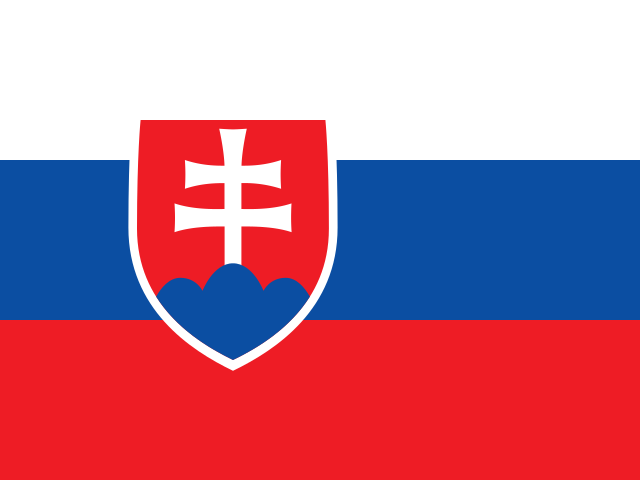
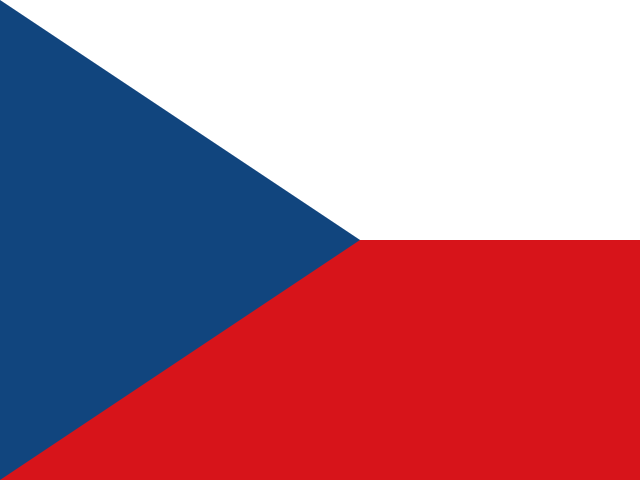


Slovak land is among Europe’s most fragmented: narrow strips with dozens of co-owners, no access and often unknown owners. Land consolidation under Act No. 330/1991 Zb. is the only tool reorganising an entire area at once, combining parcels, providing access roads and redrawing ownership boundaries. For an owner, one point matters: the proceedings continue without active participation, and the result still binds them.
The result is new property, not an adjusted old plot
The exchange is completed when the decision approving implementation becomes final.
Unofficial English translation:
On the date the decision approving implementation of the land consolidation project becomes final, or a later date specified in it, the original plots cease to exist and ownership […] or the right to cash settlement under the cash settlement list is acquired; land consolidation is completed when ownership of the new plots or the cash settlement right is acquired.
No appeal lies against this decision, and the project binds all participants (§ 14(6)). Existing leases over the original plots also end (§ 14(9)), requiring new agreements afterwards.
Opportunities to influence the outcome
The first is the original-state register. The district office publishes it for 30 days and sends each known owner an extract. Objections may be submitted within 30 days of publication or delivery (§ 10(1) and (2)). This is the last inexpensive opportunity to correct areas, shares and titles. Ownership disputes are referred for a declaratory claim, and duplicate entries receive separate treatment.
The second concerns principles for locating new plots. The office discusses each owner’s proposals and requirements (§ 11(18)). An owner who says nothing does not influence the future location. Principles are valid with approval from owners of two thirds of the area, and:
Unofficial English translation:
An owner’s failure to object, or an unfounded objection, is also deemed consent to the draft principles.
The third is the allocation plan: objections to its extract may be filed within 30 days and are discussed within 90 days (§ 13(2)). New plots must be proportionate: value differences up to 10%, or up to 25% if agreed in the principles, and area differences up to 5%. Exceeding those limits to the owner’s disadvantage requires written consent (§ 11(4) and (5)). For small areas, agricultural land up to 400 m² or woodland up to 2,000 m², cash may replace land only with the owner’s written consent, irrevocable once delivered (§ 11(8), (9) and (11)).
Watch easements too. The district office may establish or extinguish other rights in rem for consolidation purposes and determine compensation treatment in the plan (§ 11(12)). Well access, a road to the house or utility routes should therefore be protected at the draft stage. After consolidation, a contractual agreement is the usual route, but other statutory grounds for creating an easement under § 151o of the Civil Code remain available. Subject to the conditions in subsection 3, a court may also establish a right of way to a building if access cannot be secured otherwise; this is not a general entitlement to access every plot.
Czech parallel: the same logic, different figures
Czech land consolidation follows Act No. 139/2002 Sb., with sharper consequences for silence. The land office displays the schedule of entitlements for 15 days and delivers it to known owners (§ 8(1)). The preparer discusses the new arrangement with each owner, who signs agreement or disagreement. No response within an additional 15-day period after notice counts as consent (§ 9(20) and (21)). The completed draft is displayed for 30 days as the final objection opportunity; later objections are disregarded (§ 11(1)). Approval needs owners of 60% of the area (§ 11(4)). No appeal lies against the subsequent ownership exchange decision, and existing leases end on 1 October of the current year (§ 11(8)). Proportionality limits are 4% for value, 10% for area and 20% for distance (§ 10(2)–(4)). An owner burdened by a project easement receives compensation unless compensated with other land (§ 9(18)).
Practical implications
Anyone receiving a district or land office letter should immediately check areas, shares, encumbrances and whether the office knows their address. Buying land during consolidation means entering ongoing proceedings: the approved legal position binds successors. In Czechia, after project approval, land cannot be transferred or encumbered without office consent (§ 11(13) of Act No. 139/2002 Sb.). For businesses and municipalities, consolidation is also an opportunity: common facilities and measures (§ 12) provide roads and erosion protection that might otherwise require years of acquisitions.
We assess extracts and drafts and submit timely objections through land subdivision and consolidation, duplicate ownership, easements and land purchases and sales in affected areas. We practise in Slovakia and Czechia and can represent cross-border owners in both proceedings.
This article provides general legal information as at 29 August 2026. It does not constitute legal services or advice on your specific matter. Laws change and the details of your situation may differ. Check the appropriate course of action or contact us before making a decision.