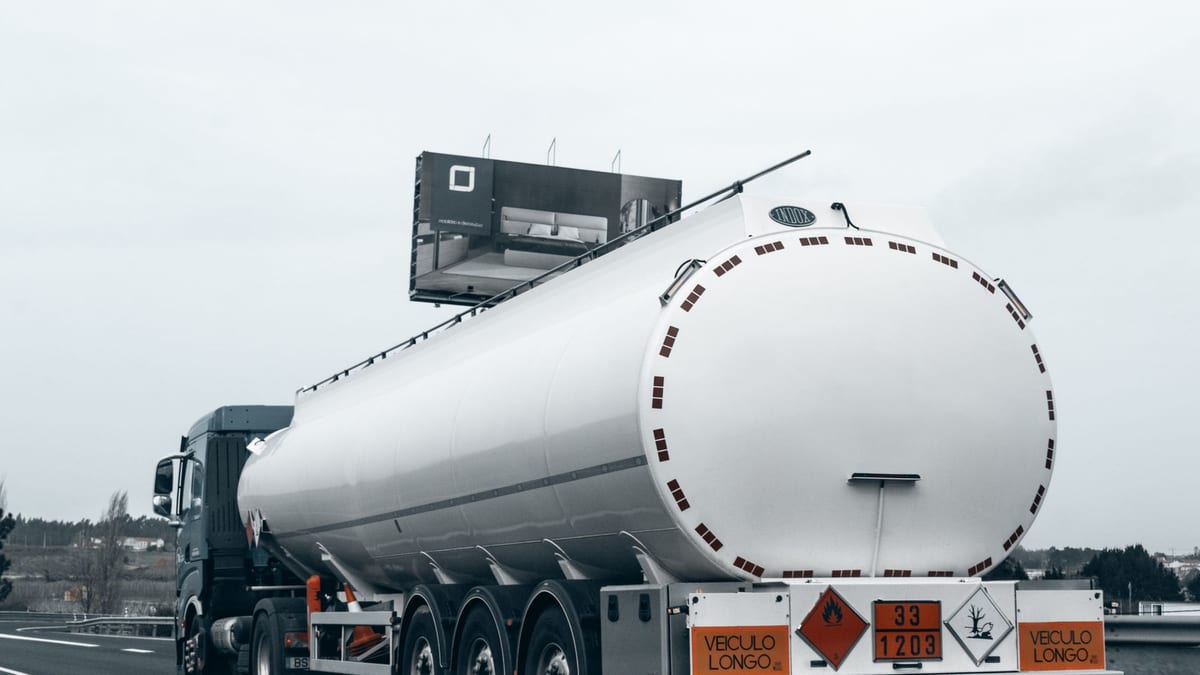
Many companies operate goods vehicles without being hauliers. A construction firm carries materials to its sites, a furniture maker delivers its own products to customers, a repair shop transports the machines it services. When the fleet is expanded, or on the first job abroad, the question arises whether a road transport operator authorisation, or even a Community licence, is needed. The answer turns on whether the carriage is for others for reward or on own account, and that dividing line is narrower than is often assumed.
Authorisation attaches to carriage for others
Act No. 56/2012 Coll. on Road Transport does not regulate every journey by a goods vehicle, but rather the business of transport:
The operation of road transport and the operation of a taxi service is a business whose object is the provision of transport services to the public for reward by road motor vehicles type-approved for that purpose (the “vehicle”).
— Section 2(1) of Act No. 56/2012 Coll. (unofficial English translation)
Regulation (EC) No 1071/2009 rests on the same basis: the occupation of road haulage operator is the activity of an undertaking carrying goods for hire or reward (Article 2(1)). The Slovak Act expressly provides, in addition, that neither authorisation nor a Community licence is required for carriage under separate regulations (Section 5(3)), which include the list of exempt carriage in Article 1(5) of Regulation (EC) No 1072/2009. One of those is precisely carriage on own account.
Five conditions that must all be met at once
The Regulation on access to the international road haulage market defines own-account carriage precisely:
(d) carriage of goods in motor vehicles which meet the following conditions: (i) the goods carried must be the property of the undertaking or must have been sold, bought, let out on hire or hired, produced, extracted, processed or repaired by the undertaking; (ii) the purpose of the journey must be to carry the goods to or from the undertaking or to move them, either inside the undertaking or outside for its own requirements; (iii) motor vehicles used for such carriage must be driven by personnel employed by, or put at the disposal of, the undertaking under a contractual obligation; (iv) the vehicles carrying the goods must be owned by the undertaking, have been bought by it on deferred terms or hired. […] (v) such carriage must be no more than ancillary to the overall activities of the undertaking;
Where the vehicle is hired, the conditions of Directive 2006/1/EC on vehicles hired without drivers must be met. The Regulation does not apply the condition of an owned or hired vehicle to a replacement vehicle during a short breakdown of the vehicle normally used. If even one of the five conditions is missing, the exemption for own-account carriage does not apply. Where the carriage is for reward, the company then needs authorisation and, for a journey to another Member State, a Community licence as well, unless another exemption applies.
Those are, in particular, the exemptions based on vehicle weight, which do not depend on whose goods are being carried. Neither authorisation nor a Community licence is required for vehicles and vehicle combinations with a maximum permissible laden mass of up to 2.5 tonnes (Section 5(3)(a) of the Act, Article 1(5)(ca) of the Regulation). In domestic transport, the Act also requires no authorisation from a haulier carrying goods only in vehicles of up to 3,500 kg (Section 5(4)(g)); that threshold does not, however, apply to journeys abroad.
Where own account most often ends
The first typical case is transport within a group. Each company is a separate undertaking, and if one of them carries goods for a sister company that it has neither bought, sold, produced nor otherwise processed, the first condition will as a rule not be met. If they also invoice each other for the carriage, the transport comes close to a service for reward. The second case is filling the return leg: after delivering its own products, the vehicle loads another company’s goods so as not to run empty, and the exemption no longer covers that journey. The third is a gradual shift in the business, where transport within the company’s activities ceases to be merely ancillary.
Operating road transport without authorisation or a Community licence carries a fine of EUR 100 to EUR 15,000 (Section 48(1)(a)). If the breach is repeated within two years of the previous fine becoming final, the authority imposes a higher fine and a ban on operating transport (Section 48(6)).
What applies even without authorisation
Own-account carriage exempts you from authorisation and a licence (Section 5(3)), not from all the rules of road transport. The rules on the carriage of dangerous goods and the rules on driving times, rest periods and tachographs, for example, are assessed separately; whether they apply to your vehicles, and when the own-account exemption helps, we examined in tachographs in vans over 2.5 tonnes. For own-account passenger transport by bus between Member States, the district office in the regional capital issues a special certificate (Section 42(g)).
How to proceed
If the company operates its own goods vehicles, it is worth going through the actual flows of goods from time to time: whose goods are carried, for whom, who drives, who owns the vehicle and what share of the company’s activities transport accounts for. If any journey falls outside the own-account regime and the company wishes to continue with it, it is time to obtain authorisation. We described the four requirements on which it rests in what you need for a road haulage authorisation, and part of the authorisation is a transport manager, whose departure is dealt with in our transport manager is leaving. We assess the regime, prepare the application and conduct the proceedings before the authority through road transport licensing.
This article provides general legal information as at 12 September 2026. It does not constitute legal services or advice on your specific matter. Laws change and the details of your situation may differ. Check the appropriate course of action or contact us before making a decision.