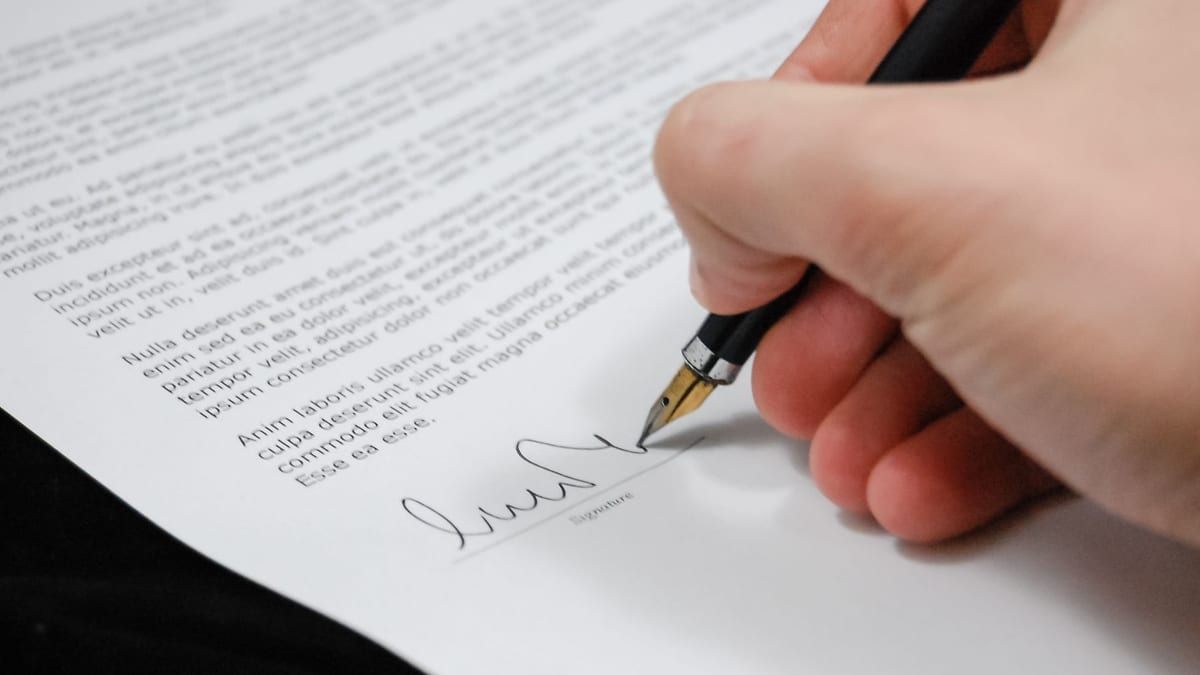
In Slovakia, most people associate signature verification with the registry office at the municipality, with the district authority or with a notary. Czech law knows one further route: verification of a signature by a lawyer, known as prohlášení o pravosti podpisu. If you are signing a document for Czech authorities, courts or the Commercial Register, it is worth knowing what this act is, what follows from it and where its scope ends.
What the lawyer confirms by the declaration
The basis lies in a single provision of the Czech Act on the Legal Profession, § 25a of Act No. 85/1996 Sb. Under its first subsection, by the declaration the lawyer states that the person signed the document in their presence in their own hand, or acknowledged the electronic signature on the document as their own. The declaration is made at that person’s request and the Act gives it the same effects as official verification of a signature.
Three things follow from the provision. The first is that a paper document must be signed in the lawyer’s presence. For a handwritten signature, the Act does not contemplate your bringing an already signed document and merely acknowledging the signature; acknowledgement as one’s own is permitted for an electronic signature. The second is that the declaration has the same effects as official verification of a signature, so it is not a weaker substitute. The third is what the declaration does not confirm: it addresses who signed the document and how, not whether the content of the document is correct or true. In that respect it corresponds to Slovak certification at a municipality or district authority (Section 14(3) of Act No. 78/2026 Coll.) and to legalisation by a notary:
By legalisation, a notary does not certify the truth of the facts stated in the document.
— Section 58(4) of Act No. 323/1992 Coll. (unofficial English translation)
What the declaration must contain
The clause is drawn up directly on the document or on a sheet firmly attached to it (§ 25a(2)). The Act prescribes its content in considerable detail (§ 25a(3)). The clause contains:
- the sequential number under which the declaration is recorded in the book of declarations of authenticity of signatures,
- the signatory’s given name, surname, date and place of birth and their address; if the document produced does not contain it, it is recorded according to their oral statement,
- identification of the document from which the lawyer ascertained the particulars,
- a statement whether the person signed the document in the lawyer’s presence or acknowledged the electronic signature as their own,
- the date and place of the declaration,
- the lawyer’s name, registration number and signature, or those of a trainee lawyer with the addition “v zastoupení”,
- for an electronic signature, the lawyer’s qualified electronic signature and a qualified electronic time stamp.
Identity and records
The signatory proves their identity with a valid document. For a citizen of the Slovak Republic, who is a foreign national from the standpoint of Czech law, the Act recognises a travel document, an identity card of a citizen of a European Union Member State, or a document authorising residence in Czechia, provided they contain a photograph (§ 25a(9)). A Slovak identity card is therefore sufficient.
Every declaration is recorded in the book of declarations of authenticity of signatures, which the Czech Bar Association issues only after the lawyer has submitted an officially verified specimen of their signature (§ 25a(4)). The book also has practical significance: under § 25b of the Czech Act on the Legal Profession, the lawyer must lend the relevant volume of the book to, among others, a court, a law enforcement authority and, on the statutory conditions, an expert appointed in the proceedings. If the signature is later disputed, the act can therefore be traced back. A lawyer may be represented for the declaration by a trainee lawyer who has submitted an officially verified specimen signature to the Bar Association, but not in the case of a document in electronic form (§ 25a(5)).
Electronic signatures
The Act also permits a declaration in respect of an electronic signature. The clause is then drawn up electronically and joined to the signed document in such a way that its integrity is not impaired (§ 25a(2)). For electronic documents, the Act expressly lists the cases in which the declaration is not made (§ 25a(6)). These include the lawyer’s own signature, a document containing no text, the absence of a valid identity document, the signature of a person other than the person present, a wholly uncompleted form, or a document in a language other than Czech or Slovak which the lawyer does not understand and for which no officially certified translation is produced. Further details of the lawyer’s duties are governed by the Bar Association’s professional rules (§ 25a(10)).
Where the limits lie
Prohlášení o pravosti podpisu is an instrument of Czech law and its natural place is documents destined for Czech proceedings: the Commercial Register, the Land Register, a court or an authority. For a Slovak document, the signature is certified by the district authority, the municipality or a notary (Section 3 of Act No. 78/2026 Coll. and Section 58(1) of the Notarial Code), and there we do not rely on the declaration. If you are signing the document in Slovakia and it is destined for Czechia, you will encounter a further limitation, which we discuss in signing a document for Czechia while living in Slovakia.
Nor does the declaration replace acts with a different content. Where the law requires a notarial deed, a verified signature will not replace it. And signature verification must be distinguished from acts in which the lawyer is also responsible for the content of the document; we explain the difference in when a verified signature is enough.
How it works with us
We first assess what form your act and the destination authority require, and only then prepare or check the document. The signing takes place at a meeting we would be having about the matter in any event, and we draw up the clause on the spot. If the verification forms part of a matter we are handling for you, it is included in the price of that service. Further details are on our signature verification by a lawyer page.
This article provides general legal information as at 12 September 2026. It does not constitute legal services or advice on your specific matter. Laws change and the details of your situation may differ. Check the appropriate course of action or contact us before making a decision.